
Klæbo and Haaland Back a $10 Million Bid to Reinvent Competitive Chess
Authored by moneromilk.com, 15 Apr 2026
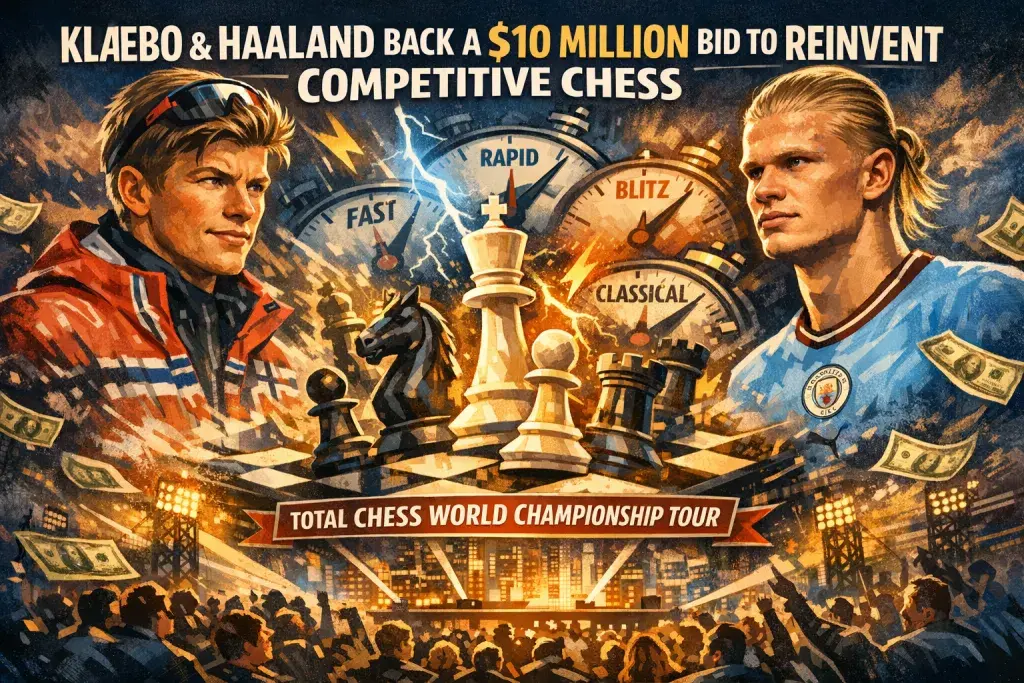
Johannes Høsflot Klæbo, the Norwegian cross-country skier who has accumulated 11 Olympic gold medals across his career, has entered the world of chess investment — joining Erling Haaland as a backer of the Total Chess World Championship Tour, a new global circuit developed under the Norway Chess umbrella. A group including Klæbo has contributed an additional $10 million to the initiative, bringing fresh capital and considerable public profile to an effort that has already secured approval from the International Chess Federation, FIDE. A pilot event is scheduled for November 10–24, with the full season set to launch in 2027.
What the Total Chess World Championship Tour Actually Proposes
The concept at the center of this investment is ambitious by the standards of professional chess. Rather than crowning a single classical World Champion — the model that has defined elite chess for well over a century — the Total Chess format seeks to identify a World Combined Champion across three distinct disciplines: Fast Classic, Rapid, and Blitz. Each of these formats differs fundamentally in time allocation per move and the cognitive demands placed on participants. Classical chess rewards deep preparation and long-horizon calculation. Rapid compresses that time pressure significantly. Blitz reduces it further still, demanding near-instinctive pattern recognition over deliberate analysis.
Combining all three into a single ranking framework is not merely an organizational decision — it reflects a genuine philosophical argument about what it means to be the world's strongest chess mind. A combined format rewards versatility and psychological resilience across radically different conditions. It also produces more content, faster, which matters considerably when the goal includes growing a global audience. Arctic Securities, the Norwegian financial firm, is advising on and placing the capital raise, signaling that this is being structured as a serious commercial venture rather than a prestige vanity project.
Why Celebrity Capital Is Flowing Into Chess Right Now
The involvement of two of Norway's most recognizable names is not coincidental. Norway has an unusually deep relationship with chess at the national level, shaped in large part by Magnus Carlsen, who held the classical World Championship title for over a decade and remains the highest-rated active player in the world. That cultural familiarity has made chess a credible investment category domestically in a way that would be less intuitive in most other countries.
More broadly, chess has undergone a significant shift in its global visibility over the past several years. Online platforms have drawn tens of millions of new users. Streaming has created a new generation of chess personalities with audiences that rival those of major entertainment figures. The pandemic period accelerated this adoption sharply, and the numbers have not fully retreated. Investors and media companies have taken notice. The question for any new competitive structure is whether it can convert that diffuse interest into a loyal, monetizable audience — and whether the format itself is compelling enough to sustain attention over a full season rather than a single high-stakes event.
FIDE Approval and the Road to 2027
FIDE's endorsement of the pilot is consequential. The federation controls the legitimacy of World Championship titles in chess, and any new circuit that operates outside its framework risks being perceived as peripheral regardless of the capital behind it. Securing that approval before the pilot phase means the Total Chess initiative is working within the established governance structure rather than attempting to fracture it — a distinction that matters both to elite participants and to audiences who follow the official title lineage.
The November pilot will serve as a proof of concept. A great deal depends on execution: the quality of the field assembled, the clarity of the format for audiences unfamiliar with multi-discipline chess, and the extent to which media coverage translates investment into visibility. The 2027 full launch gives organizers meaningful time to refine the model based on what the pilot reveals. Whether the combined format produces a genuinely compelling competitive narrative — or whether it dilutes the singular drama that has historically defined World Championship chess — is a question that only live events can answer.